Friday, November 4, 2016

Tapola - near Koyna River / Shivsagar lake


We were on a 3 day trip to Mahabaleshwar. Though I make every effort to ensure that we donot visit any of the places normally flocked by tourists, Tapola was never part of the list. We had been to Wai during the morning ( refer the blogs on Dhom Lake and Lakshmi Narasimha Temple ) and we were reasonably tired. But our driver was adamant that we go to Tapola. So with great reluctancy we set out for Tapola. It just showed that no matter what research you do, there are going to be a few other places which can take your breath away. 

The route from Mahabaleshwar to Tapola was fantastic - not for the roads but for the greenery. At some stretches it was just valleys on one side with the Koyna river showing off its curves at several places. We also had Ilayaraja's songs for company and with the weather being really pleasant, it was actually heaven on earth. 

The distance from Mahabaleshwar to Tapola is about 30 kms through winding roads and should take about an hour at best. There is not much traffic once you cross the vicinity of Mahabaleshwar. 


Since it was almost 3-4 months past the monsoons, the water levels had receded. Note the snap below. During peak rainy season, the water levels are near the trees as per the locals but at that time they also stop the boating and the place almost becomes inaccessible. 


However we had the privilege to drive right upto near the boat which you see in the snap. Infact there were cars being transported via the large boat to the other side of the bank. Saves a lot of time rather than taking the circuitous route through the hills. 


When we reached there, the sun was just about to set and sky was filling itself with beautiful hues of golden and orange. There was the option to take the boat ride but neither myself nor my wife and kid are great fans of boating. So we instead just settled on the banks gazing away at the boats fading into the different corners and enjoying the minor changes which the sunset causes to the colors of the surroundings. There were hardly a handful of people there and believe me, it is a meditative experience.  


The sunset was just gorgeous with the sun rays piercing through the cold January evening, the lake staying perfectly still reflecting the golden evening rays, the boats just mildly swaying away to the ever so gentle breeze.


On the way back to Mahabaleshwar, we stopped at this place just adjacent to a tiny shop. Notice how the river takes the shape of a horse. 

Finally a big thank you for our driver to have persisted on us to travel to this location. 

Sewree Flamingo Point - Mumbai


The flamingos date with the mudflats of Sewree started in 90s and since then they have kept the date every year. These flamingos arrive at Kutch in Gujarat in end November and they come over to the Sewree mudflats around February. Sewree mudflats has a lot of Mangroves which acts as a food and shelter option for these lesser flamingos. So when the tide is low and the water recedes exposing the mudflats thousands of flamingos converge on them for feeding which is a site to behold. 

The place is very easily accessible and google maps has a place tagged as Sewree flamingo point itself. I have given a screen shot for reference. 


My camera kit basically has 18-55mm, 50mm prime, 100mm macro lens and my trusted companion 55-250 mm. If I have been to one place where I felt my kit was inadequate, it was this place. The flamingos get into a feeding frenzy quite far away from the viewing point and it was very difficult to get a close up shot. Knowing the subject I was photographing I was also carrying a Fujifilm HS 10 which has a 30x zoom but that didnt give me stable images. So if you are a serious photographer carry a better telephoto lens for better captures. 

Another key point to take into account while visiting this place is the tide. During high tide, the water gets very close to the shores and hence the flamingos normally retreat into the mangroves. During low tide when the water recedes, they come over in droves for feeding in the mud flats. Look up online for the tide timings and ensure you go there during the low tide. Else you will be in for disappointment. 

Apart from the flamingos there are a variety of other birds as well which can be spotted here. Bombay Natural Historic Society ( BNHS ) organises lots of guided tours at reasonable rates. You can look up their website for the details. Also sometimes boats get dismantled here and there are several other boats docked up near the shore which can be pretty to photograph. 

And hmmmm before I forget, its also the place in Mumbai where you can watch a sunrise next to the beach. 


Points to remember

  • Do carry water, hat, a good camera, preferably binoculars.
  • The place is quite away from the main roads and hence vehicles are sparse. Preferably bring your own vehicle. Walking back is not a great option as the distance is quite high. 
Some photos from the visit. 


Sunday, October 16, 2016

Ovlekarwadi Butterfly farm - A photo blog


Amidst all the concrete jungle of Mumbai, there is a quiet place off Ghodbunder Road in Mumbai where a naturalist Ovalekar has created a butterfly garden which is an absolute haven for kids to learn about nature, life cycle of butterfly, how even kids can contribute to conservation efforts, its importance and at the same time get to see a significant variety of butterflies and photograph them. The place is quite easy to identify as the location is available on google maps. Its a small turn off Ghodbunder road and about a km from the main road. Its open only on Sundays between 7AM and 2 PM. Ample parking space is available. There is a small registration fee which is charged. You can order break fast as well over there if you prefer. Its a simple food - no varieties but serves the purpose. Its served along with tea or juice. 

There is a small session where the owner takes you through the importance of conservation measures, how everyone can contribute towards the same, basic life cycle of butterfly etc. Then there are session where you can see the live birth of the butterfly. Kids also get to hold the catterpillars in their hand ( not directly but via leaves ). Its an excellent opportunity for kids to be introduced to these winged creatures. He also takes the kids around and introduces them to the various species of butterflies in the place. Its a real delight to watch the winged creatures at such close quarters and in such large numbers. 

The butterflies generally tend to come out when the sun is out. So in winter especially, they take their own sweet time to come out ( Just like we snug into the blankets in winter ). So you go too early, you may be disappointed. Also a little patience helps especially if you are there to photograph. People get frustrated and leave by 10-10.30 AM in the morning while many of the butterflies tend to come out in large numbers after that. For best results, visit the place twice - one during winter and another during October for best results. You will get to see most of the species which come over there. 

The below photos were all taken two visits - Feb 16 and Oct 16. 

Common Jezebel

Blue Tiger
Glassy Tiger


Glassy Tiger

Danaid Eggfly

Pea Blue

Great Orange Tip

Common Bluebottle


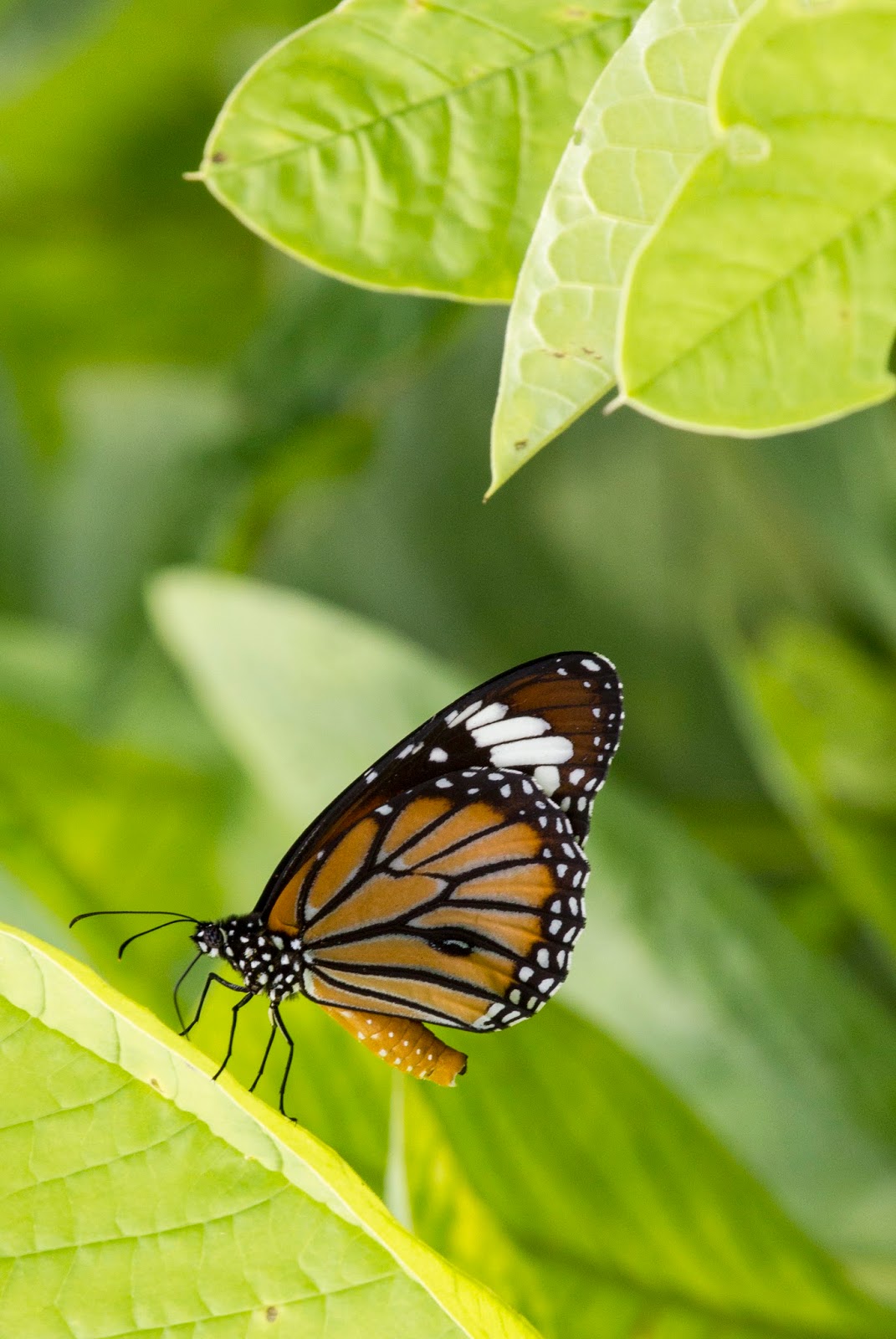
Striped Tiger

Common Bushbrown

Common Pierrot

Psyche


Common Mormon

Tailed Jay

Common Crow


Grass Demon

Common Mormon


Blue Oak Leaf


Thats the plain tiger emerging


Name not sure. May be Common Gull